01 / Interior designers
What a website for an interior designer has to do
Clients rarely hire an interior designer from one photo. They look for a sign that you understand people like them: their kind of home or business, their budget, their taste. A beautiful gallery alone does not answer that. A good site does three things in order: it shows work that the right client recognises, it explains your process so the price makes sense, and it makes the first step easy.
The other side matters just as much: it should keep out enquiries you cannot take. A form that asks for location, project type, rough budget and timing saves you calls that go nowhere.
02 / Interior designers
What we build
Project-led portfolio
Each project gets its own page with the brief, the constraints and the result, not just ten photos. Filters by residential, hospitality or commercial work help visitors find what is relevant to them.
Services and process
A clear page on how you work, from first consultation to installation, so clients understand what they pay for before they call.
Qualifying enquiry form
Questions on location, project type, budget range and timing, sent straight to your inbox in a format you can answer quickly.
Journal and press
A simple place for project stories, press mentions and awards, which also gives Google more to index.
Several languages
Many studios work for international clients. We build multilingual sites with proper hreflang, written natively in English, German and Portuguese.
Local search
A fast site with clean structure and a matching Google Business Profile, so people searching near you find you.
03 / Interior designers
Case study: Daradiant Interiors in Lisbon
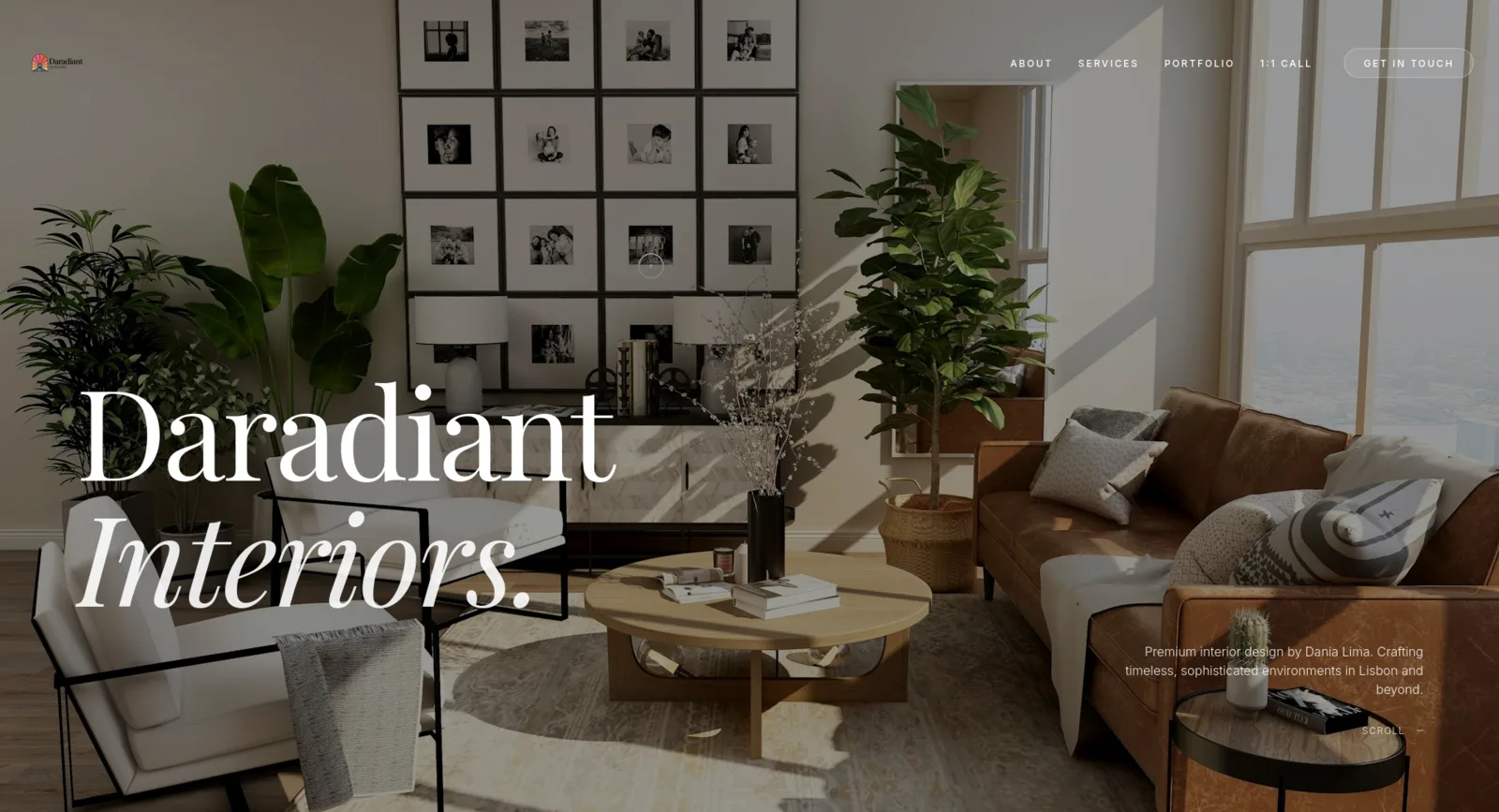
Daradiant is an interior design studio in Lisbon. It needed a brand world that carries the quiet confidence of its interiors without becoming cold, generic or over-designed. We built a restrained identity around an elegant serif wordmark, editorial typography, warm neutrals and generous space, and a website that lets the work breathe while guiding potential clients towards a consultation call.
The result is an image-led portfolio with a calm structure around services, portfolio and a direct route to a call, plus an identity system with wordmark, typography and imagery guidance that the studio uses every day. See the full Daradiant case study.
04 / Interior designers
Branding and website design for interior designers, together
Many interior designers come to us with a logo made years ago and a website that no longer matches their work. Doing branding and web design in one project is usually cheaper and faster than doing them one after the other, and the result is consistent: the same typography on your proposals, your Instagram and your site.
If your brand is fine as it is, we design the website around it.
05 / Interior designers
Website builder template or studio-built site?
Template builders are a reasonable start. Here is where the difference shows. Our article website builder or web studio goes deeper.
| Aspect | Builder template | Studio-built site |
|---|---|---|
| Look | Shared with many other studios | Built around your brand and your work |
| Portfolio | Galleries | Project stories with brief, process and result |
| Enquiries | Generic contact form | Form that qualifies budget, location and scope |
| Speed with many large photos | Often slow on phones | Optimised images, fast on mobile |
| Languages | Often an add-on or machine translation | Proper multilingual setup, written natively |
| Monthly cost | Subscription to the builder | Hosting of your choice, you own the site |
06 / Interior designers
How a project runs
- 01
Discovery call
We talk about your clients, your best projects and what kind of work you want more of.
- 02
Fixed quote
You get a fixed price and timeline. 50 % at the start, 50 % at launch.
- 03
Structure and design
We plan the pages and the portfolio, then design the key screens for you to approve.
- 04
Build and content
We build the site, prepare your photos for the web and help with texts where you need it.
- 05
Launch and after
We launch and set up search basics. After that, new projects, photos and journal posts go live through us: you send the material, we add it without touching the rest of the layout, as part of care or at a fixed price.
07 / Interior designers
What it costs
Websites start at €1,500, and most projects go live in 2–6 weeks. A site with a larger portfolio, several languages or a new brand identity costs more; you get a fixed quote after a short call. For a broader view of the market, read our guide on what a website costs.
FAQ
Common questions
01What should an interior designer's website include?
A portfolio organised by project with context, a page about your services and process, an about page that shows who you are, and an enquiry form that asks for location, project type, budget and timing. A journal or press section helps both trust and search.
02How many projects should I show in my portfolio?
Fewer than you think. Six to ten strong projects that match the work you want more of are better than every project you have ever done.
03Do you also design the logo and brand?
Yes. Many interior design studios combine branding and website in one project, as Daradiant Interiors did. If your brand already works, we build the website around it.
04Can I update the portfolio myself?
No, and you do not need to. We hand-code the site without a CMS, which keeps it fast with many large photos and leaves no plugins to patch. When a project is finished, send us the photos and a few lines about the brief, and we build the project page quickly and in the same quality as the rest: as part of website care or at a fixed price.
05How much does a website for an interior designer cost?
Our websites start at €1,500. The final price depends on the size of the portfolio, the number of languages and whether branding is included. You get a fixed quote before we start.
06Do you work with interior designers outside Portugal?
Yes. We work remotely with clients across Europe, in English, German and Portuguese.